
Introduction
Let me be honest with you — the first gluten free cake I ever made was a disaster. It was dense, gummy in the middle, had a slightly gritty texture, and tasted nothing like the celebration cake it was supposed to be. I was embarrassed to serve it and quietly slid it into the trash before the birthday party started.
That was years ago. Since then, I’ve made dozens — no, probably hundreds — of gluten free cakes. I’ve tested different flour blends, played around with fat ratios, figured out the exact role that xanthan gum plays, and discovered a few game-changing tricks that most recipes don’t tell you. And today, I’m sharing the result of all that trial and error: the best gluten free cake recipe I’ve ever made.
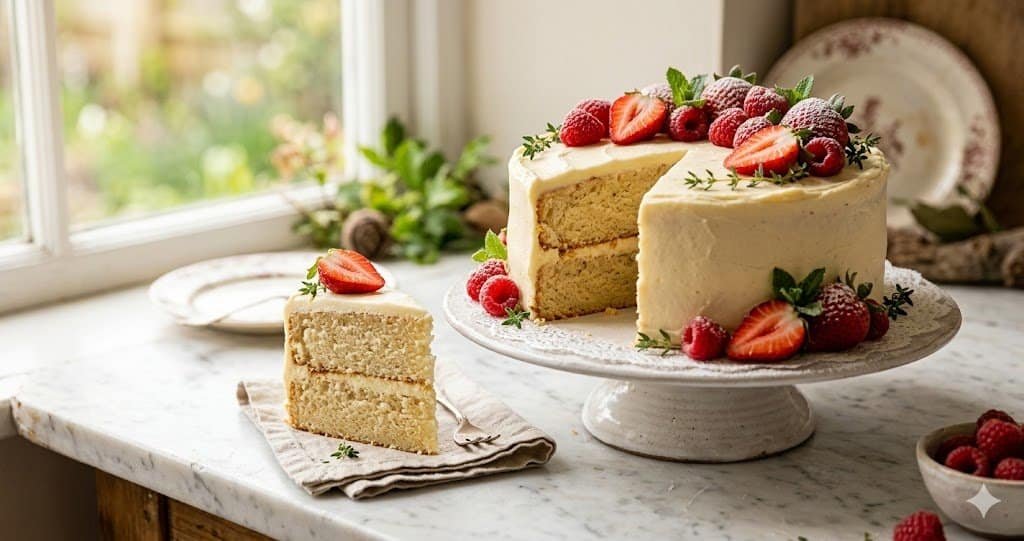
This is a classic vanilla layer cake that just happens to be gluten free. It’s tender, moist, fluffy, and full of real flavor. Nobody sitting at your table will know it’s gluten free unless you tell them. I’ve served it at birthday parties, Easter dinners, baby showers, and regular Tuesday nights when I just needed cake — and it has impressed every single time.
Whether you’re new to gluten free baking or you’ve been at it for years and are just looking for a more reliable recipe, you’ve landed in exactly the right place. Grab your mixing bowls. Let’s do this together.
Why You’ll Love This Recipe
- ✅ Incredibly moist and tender — thanks to a smart combination of butter, oil, and sour cream that keeps every bite soft
- ✅ No gummy texture — the right flour blend and resting time eliminate that dreaded gluey middle
- ✅ Made with pantry staples — no specialty ingredients that require a trip to three different stores
- ✅ Works for multiple occasions — dress it up with fancy frosting for a birthday or keep it simple for a weeknight dessert
- ✅ Freezer-friendly — bake the layers ahead and freeze them, making party prep so much easier
- ✅ Easy to customize — chocolate, lemon, almond… so many flavor variations work beautifully with this base
- ✅ Beginner-friendly — the steps are straightforward and forgiving, even if you’re new to gluten free baking
- ✅ Dairy-free adaptable — simple swaps make this work for multiple dietary needs
Quick Recipe Information
| Detail | Value |
|---|---|
| Prep Time | 20 minutes |
| Cook Time | 32–35 minutes |
| Rest/Cool Time | 1 hour |
| Total Time | Approximately 1 hour 55 minutes |
| Servings | 12 slices |
| Calories | ~285 per slice (cake only, without frosting) |
| Cuisine | American |
| Course | Dessert |
| Difficulty | Easy to Intermediate |
Ingredients
Main Ingredients
- 2 cups (280g) gluten free all-purpose flour blend — I prefer Bob’s Red Mill 1-to-1 or King Arthur Measure for Measure
- 1 teaspoon xanthan gum — only add this if your flour blend doesn’t already include it
- 1½ cups (300g) granulated white sugar
- 2 teaspoons baking powder
- ½ teaspoon baking soda
- ½ teaspoon fine sea salt
- 3 large eggs — at room temperature (this is important!)
- ½ cup (113g) unsalted butter — softened to room temperature
- ½ cup (120ml) neutral oil — avocado oil or vegetable oil both work great
- 1 cup (240g) full-fat sour cream — room temperature
- 2 teaspoons pure vanilla extract
- ¼ cup (60ml) whole milk — room temperature
Optional Ingredients / Additions
- 1 tablespoon fresh lemon zest — for a bright citrus flavor
- ½ teaspoon almond extract — adds a lovely depth to the vanilla base
- ¼ cup rainbow sprinkles — fold into the batter for a funfetti version
- 2 tablespoons cocoa powder — replace 2 tablespoons of flour for a marble effect
- Pinch of nutmeg — adds warmth, especially nice in autumn
Ingredient Notes
Gluten Free Flour Blend: Not all GF flour blends are created equal — trust me, I’ve learned this the hard way. The best results come from a blend that already contains a mix of rice flour, tapioca starch, and potato starch. These blends mimic the texture of all-purpose wheat flour most closely. Avoid single-grain flours like almond flour or coconut flour for this particular recipe; they behave completely differently and would require an entirely different formula.
Xanthan Gum: This is the ingredient that holds everything together in gluten free baking. Gluten in regular flour acts like a structural net, trapping air bubbles and giving baked goods their structure. Xanthan gum does the same job. Without it (or without a flour blend that already contains it), your cake will crumble and fall apart.
Sour Cream: This is my secret weapon. Full-fat sour cream adds incredible moisture while also making the crumb tender and tight. It also introduces a very subtle tang that makes the overall flavor more complex and interesting. Don’t swap it for low-fat — you’ll miss out on that luxurious texture.
Both Butter AND Oil: Using both is intentional. Butter gives flavor and structure; oil gives moisture that stays even after the cake cools. Cakes made with only butter can dry out, while cakes made with only oil lack depth of flavor. Together, they’re a powerhouse combination.
Room Temperature Ingredients: Every egg, every dollop of sour cream, every splash of milk needs to be at room temperature. Cold ingredients don’t emulsify properly, and in gluten free baking especially, a broken emulsion leads to a dense, uneven crumb. Pull everything out of the fridge at least 45 minutes before you start.
Kitchen Equipment Needed
- Two 9-inch round cake pans
- Parchment paper
- Stand mixer or hand mixer with beaters
- Two large mixing bowls
- Wire cooling rack
- Rubber spatula
- Kitchen scale (highly recommended for gluten free baking)
- Sifter or fine mesh strainer
- Toothpick or cake tester
- Offset spatula (for frosting)
- Bench scraper (optional, but helpful for smooth sides)
Step-by-Step Instructions
Step 1: Preheat Your Oven and Prepare Your Pans
Preheat your oven to 350°F (175°C). Grease both 9-inch round cake pans generously with butter or cooking spray, then line the bottoms with parchment paper circles. Grease the parchment paper too.
Why this matters: Gluten free cakes are more delicate than traditional cakes and can stick stubbornly to the pan. Parchment paper is your insurance policy against a crumbled disaster when you try to unmold the layers.
Step 2: Whisk Together the Dry Ingredients
In a large bowl, combine the gluten free flour, xanthan gum (if needed), sugar, baking powder, baking soda, and salt. Whisk everything together thoroughly for a full minute.
Why this matters: Even distribution of leavening agents is crucial. A pocket of baking powder in one spot can cause uneven rising and odd-tasting bites. Take your time here.
Visual cue: The mixture should look uniform — no visible clumps of any one ingredient.
Step 3: Cream the Butter
In the bowl of your stand mixer (or using a hand mixer), beat the softened butter on medium-high speed for about 3 full minutes until it’s pale, light, and fluffy.
Why this matters: Creaming butter properly incorporates tiny air bubbles that help your cake rise and stay light. This step is one that most home bakers rush, and it shows in the final texture.
Common mistake: Using butter that’s too soft or even melted. It should hold a fingerprint when you press it but not feel cold and hard.
Step 4: Add the Wet Ingredients
With the mixer on medium speed, add the oil and mix until combined. Then add the eggs one at a time, beating for about 20 seconds after each addition. Add the vanilla extract. Finally, mix in the sour cream and milk. Scrape down the sides of the bowl and mix one final time until the batter is smooth and uniform.
Why this matters: Adding eggs one at a time helps maintain the emulsion. If you dump them in all at once, the batter can look curdled, which affects the final texture.
Visual cue: The batter should look smooth, creamy, and slightly glossy at this point.
Step 5: Fold in the Dry Ingredients
Pour the dry ingredient mixture into the wet ingredients in two additions, gently folding with a rubber spatula after each addition. Stop mixing as soon as you no longer see dry streaks — a few small lumps are completely fine.
Why this matters: Overmixing gluten free batter develops excess starch and can make the cake gummy. Fold, don’t beat.
Common mistake: Continuing to mix “just a little more” to get a perfectly smooth batter. Resist the urge.
Step 6: Let the Batter Rest
Here’s a step most recipes skip entirely, and it makes a huge difference: let the batter sit in the bowl for 5 minutes before transferring it to the pans.
Why this matters: Gluten free flours — especially those with rice flour — need a little time to fully hydrate. Resting the batter results in a smoother crumb and reduces that gritty texture that plagues so many GF cakes.
Step 7: Fill the Pans and Bake
Divide the batter evenly between the two prepared pans. Use a kitchen scale for accuracy if you have one. Smooth the tops gently with an offset spatula or the back of a spoon.
Bake for 32 to 35 minutes, rotating the pans halfway through for even baking.
Visual cue: The tops should be lightly golden, pulling away slightly from the sides of the pan, and a toothpick inserted into the center should come out clean or with just a few moist crumbs — not wet batter.
Step 8: Cool Properly
Let the cakes cool in the pans on a wire rack for 10 minutes. Then run a thin knife around the edges and carefully invert onto the rack to cool completely — at least 1 hour — before frosting.
Why this matters: Frosting a warm cake is one of the most common baking mistakes. The frosting melts, the layers slide, and everything becomes a sticky mess. Patience here is truly rewarded.
Expert Tips for Success
- Weigh your flour. A cup of GF flour can range from 120g to 160g depending on how it’s scooped. The scale removes all guesswork.
- Check your baking powder freshness. Old baking powder is one of the top reasons cakes don’t rise properly. Test it by dropping a teaspoon into hot water — it should bubble vigorously.
- Don’t skip room temperature ingredients. Cold eggs and dairy can cause the batter to curdle and lead to a dense cake.
- Use full-fat dairy. This isn’t the place to cut calories by using low-fat sour cream or skim milk. Full fat equals better texture.
- Rotate your pans halfway through baking. Most ovens have hot spots, and rotating ensures even browning.
- Don’t open the oven door in the first 20 minutes. Rapid temperature changes can cause the cake to sink in the middle.
- Use a kitchen thermometer if in doubt. The internal temperature of a fully baked cake should reach about 200-205°F (93-96°C).
- Cool completely before frosting — really. Set a timer if you have to. I’ve ruined more than one cake by being impatient.
- Chill your cake layers before stacking. Even 20 minutes in the fridge makes the layers firmer and easier to handle, especially when adding frosting.
- Make the cake a day ahead. Like many baked goods, this cake actually tastes better the next day as the flavors meld and the texture settles. If possible, bake on day one, frost on day two.
- Use a serrated knife to level your layers. A flat, even surface makes for a more professional-looking finished cake.
- Apply a crumb coat. A thin first layer of frosting traps any loose crumbs. Chill for 20 minutes, then apply the final coat for a flawless finish.
Recipe Variations
🍫 Chocolate Gluten Free Cake Version
Replace ½ cup of the gluten free flour with ½ cup of unsweetened Dutch-process cocoa powder. Add ½ cup of hot coffee to the batter (it intensifies the chocolate flavor without making the cake taste like coffee). Increase sugar to 1¾ cups. Frost with a rich chocolate ganache or classic chocolate buttercream.
🍋 Lemon Gluten Free Cake Version
Add 2 tablespoons of fresh lemon zest and replace the milk with fresh lemon juice. Reduce vanilla to 1 teaspoon and add ¼ teaspoon of lemon extract for a brighter flavor. Pair with lemon curd filling and a whipped cream cheese frosting.
🌱 Vegan Gluten Free Cake Version
Replace eggs with flax eggs (1 tablespoon ground flaxseed + 3 tablespoons water per egg, rested for 5 minutes). Use vegan butter, full-fat coconut cream instead of sour cream, and oat milk or almond milk in place of whole milk. Results are slightly denser but still delicious.
🥛 Dairy-Free Gluten Free Version
Swap butter for refined coconut oil or a good-quality vegan butter like Miyoko’s. Replace sour cream with full-fat coconut yogurt and use any non-dairy milk. This version is naturally vegan as well with the egg swap above.
🍰 Low-Calorie Gluten Free Version
Reduce butter to ¼ cup and replace the remaining with unsweetened applesauce. Swap sour cream for low-fat Greek yogurt and reduce sugar to 1 cup. The texture will be slightly less rich, but the cake is still wonderfully moist and satisfying.
🎉 Funfetti Gluten Free Birthday Cake Version
Fold ½ cup of gluten-free-certified rainbow sprinkles into the finished batter just before pouring into the pans. Top with a vanilla buttercream and more sprinkles. Kids absolutely go wild for this one.
What to Serve With Gluten Free Cake
Frosting Ideas:
- Classic American buttercream (butter, powdered sugar, vanilla, splash of cream)
- Swiss meringue buttercream (silky, less sweet, bakery-style)
- Cream cheese frosting (tangy and dreamy)
- Fresh whipped cream (light and elegant)
- Chocolate ganache drip (dramatic and delicious)
Toppings:
- Fresh strawberries, raspberries, or blueberries
- Toasted coconut flakes
- Candied lemon slices
- Edible flowers for a stunning presentation
- Dust of powdered sugar for simplicity
Drinks to Pair:
- Earl Grey tea or chamomile tea
- Sparkling water with citrus
- Vanilla latte or cappuccino
- A glass of Prosecco or Champagne for celebrations
- Cold milk (classic and never wrong)
Other Desserts to Serve Alongside at Parties:
- Gluten free brownies
- Macarons (naturally GF!)
- Fruit salad with mint and honey
- Gluten free shortbread cookies
Storage Instructions
Refrigerator
Unfrosted cake layers: Wrap each layer individually in plastic wrap and store at room temperature for up to 2 days, or refrigerate for up to 5 days.
Frosted cake: Store covered in the refrigerator for up to 5 days. Use a cake dome or gently press plastic wrap against any cut surfaces to prevent them from drying out. Pull the cake out of the refrigerator 30 minutes before serving — it tastes so much better at room temperature.
Freezer
Unfrosted layers: This is my preferred approach for make-ahead baking. Once the layers are completely cool, wrap each one tightly in two layers of plastic wrap, then a layer of aluminum foil. Freeze for up to 3 months. Thaw overnight in the refrigerator or at room temperature for 2-3 hours before frosting.
Frosted slices: Place individual slices on a parchment-lined baking sheet and freeze until solid (about 1 hour). Then wrap each slice individually and store in a zip-lock freezer bag for up to 2 months. This is perfect for when you want a single serving of cake without committing to an entire cake.
Reheating Methods
- Refrigerated slices: Bring to room temperature on the counter for 20-30 minutes. You can also microwave on low power for 10-15 seconds if you prefer it slightly warm.
- Frozen slices: Thaw in the refrigerator overnight, then bring to room temperature before eating. Avoid microwaving from frozen as it can make the texture gummy.
Nutritional Information
Per serving (1 slice, 1/12 of a two-layer 9-inch cake without frosting)
| Nutrient | Amount |
|---|---|
| Calories | 285 kcal |
| Total Carbohydrates | 38g |
| Dietary Fiber | 1.2g |
| Total Sugars | 24g |
| Total Fat | 13g |
| Saturated Fat | 7g |
| Unsaturated Fat | 5g |
| Trans Fat | 0g |
| Protein | 4g |
| Sodium | 210mg |
| Potassium | 98mg |
| Calcium | 68mg |
| Iron | 0.8mg |
| Cholesterol | 72mg |
| Vitamin A | 6% DV |
| Vitamin C | 0% DV |
Note: Nutritional values are estimates and will vary depending on the specific flour blend and other brands used. Adding frosting will significantly increase calorie and sugar content.
Common Mistakes to Avoid
- Using the wrong flour. Single-ingredient flours like almond or coconut flour cannot be swapped 1:1 here. Use a proper multi-blend GF all-purpose flour.
- Forgetting xanthan gum. If your flour blend doesn’t contain it, your cake will crumble apart. Always check the label.
- Adding too much xanthan gum. More is not better. Too much creates a gummy, rubbery texture. Stick to exactly 1 teaspoon.
- Using cold eggs and dairy. Cold ingredients don’t emulsify properly and lead to a dense, uneven crumb.
- Not creaming the butter long enough. Those 3 minutes aren’t optional. They’re building the foundation of your cake’s texture.
- Overmixing after adding flour. Once the flour goes in, mix only until combined. Every extra stroke toughens the crumb.
- Skipping the batter rest. Five minutes of rest makes a measurable difference in texture and reduces grittiness.
- Opening the oven door too early. Resist the urge to peek until at least the 25-minute mark.
- Underbaking. Gluten free cakes can look done on the outside while still being underbaked in the center. Always use a toothpick AND check that the edges are pulling away from the pan.
- Frosting a warm cake. Your frosting will melt, your layers will slide, and you’ll be sad. Cool the cake completely — no shortcuts.
- Not using parchment paper. Gluten free cakes stick more than traditional cakes. Don’t skip the parchment.
- Using a different pan size without adjusting time. A 9×13 inch pan will require a different baking time than two 9-inch rounds. Adjust accordingly and watch carefully.
Frequently Asked Questions
1. What is the best gluten free flour for cake?
For this recipe, I recommend a high-quality multi-blend gluten free all-purpose flour like Bob’s Red Mill 1-to-1 Baking Flour or King Arthur Measure for Measure. Both contain a blend of starches and already include xanthan gum, which simplifies the process considerably.
2. Why is my gluten free cake gummy in the middle?
Gumminess is usually caused by one of three things: too much xanthan gum, underbaking, or not letting the batter rest before baking. Check your xanthan gum amount, bake until the toothpick comes out completely clean, and always rest your batter for 5 minutes before filling the pans.
3. Can I make this cake without eggs?
Yes! Use flax eggs — 1 tablespoon of ground flaxseed mixed with 3 tablespoons of water for each egg. Let the mixture sit for 5 minutes to gel before adding. The texture will be slightly denser, but the cake will still be delicious.
4. Can I make this recipe as cupcakes?
Absolutely. Fill lined muffin tins about ⅔ full and bake at 350°F for 18-22 minutes. This recipe makes approximately 18-20 cupcakes.
5. How do I know when the gluten free cake is fully baked?
A toothpick inserted in the center should come out clean or with a few moist crumbs (not wet batter). The edges should be pulling away from the sides of the pan, and the top should spring back when lightly pressed.
6. Is this cake safe for people with celiac disease?
The recipe itself uses only gluten free ingredients, but if you’re baking for someone with celiac disease, you must ensure that all your ingredients — flour, baking powder, vanilla extract, and others — are certified gluten free and that your kitchen and equipment have been thoroughly cleaned to prevent cross-contamination.
7. Why does my gluten free cake taste gritty?
Grittiness usually comes from rice flour that hasn’t fully hydrated. Resting the batter for 5 minutes before baking helps significantly. Using a finer-ground flour blend (like King Arthur) also reduces this issue.
8. Can I make this cake ahead of time?
Yes, and I actually recommend it! The cake tastes even better the next day. Bake the layers up to 2 days ahead, wrap well, and store at room temperature. Frost the day you plan to serve it.
9. Can I use this recipe to make a three-layer cake?
You can! Simply divide the batter among three 9-inch pans — the layers will be thinner, so reduce the baking time to about 22-26 minutes. Check early and watch carefully.
10. What frosting works best with gluten free cake?
American buttercream is the easiest and most forgiving. If you want something more elevated, Swiss meringue buttercream is silky and less sweet. Cream cheese frosting is a fantastic option for lemon or spice variations. All of these are naturally gluten free.
Final Thoughts
Here’s the thing I want you to walk away knowing: gluten free baking doesn’t have to mean settling for less. This cake — with its tender, moist crumb, delicate vanilla flavor, and satisfying texture — stands completely on its own merits. It just happens to not contain gluten.
I’ve watched guests go back for a second slice at parties, completely unaware it was gluten free. I’ve made it for kids who declared it the best birthday cake they’d ever had. I’ve eaten it myself, standing at the kitchen counter, and felt genuinely happy with every single bite.
So whether you’re baking this because you or someone you love has a sensitivity or celiac disease, or whether you’re simply curious about gluten free baking, I want you to feel confident going into this. Follow the steps, trust the process, resist the urge to rush the cooling, and you will end up with a beautiful, delicious cake that you’ll want to make again and again.
Now go bake something wonderful. And when you do, I’d genuinely love to hear how it turns out — drop a comment, leave a star rating, or tag me in your photos. There’s nothing that makes my day quite like seeing someone nail this recipe for the first time.
Happy baking! 🎂